


San Francisco Bay Mercury TMDL
Background
| San Francisco Bay supports beneficial uses, such as sport fishing and habitat for wildlife and endangered species. Fish tissue collected from San Francisco Bay often contains relatively high concentrations of mercury. The California Office of Environmental Health Hazard Assessment has issued fish consumption advisories warning people to limit their consumption of San Francisco Bay fish. In addition, studies have shown that birds consuming fish and other organisms from San Francisco Bay pass mercury to their eggs, potentially contributing to reproductive failures. The San Francisco Bay Mercury TMDL Project examines this water quality problem and identifies sources of mercury. Sources of mercury include runoff from historic mines, urban runoff, wastewater discharges, atmospheric deposition, and resuspension of historic deposits of mercury-laden sediment already in San Francisco Bay. Most of the historic mercury deposits date back to the Gold Rush of the 1800's, when mercury was mined throughout the Coastal Range and used in the Sierra Nevada to extract gold. The single largest source is the Central Valley, where rivers carry mercury from remote regions of California to San Francisco Bay. |
 |
TMDL Approved by USEPA
On February 12, 2008, the U.S. Environmental Protection Agency approved a Basin Plan amendment incorporating a TMDL for mercury in San Francisco Bay and an implementation plan to achieve the TMDL. The TMDL was approved by the State Office of Administrative Law and became effective on November 7, 2007. The Water Board is now implementing the TMDL on the variety of fronts described below.Regulatory Documents
The San Francisco Bay Mercury TMDL was considered and adopted by the Water Board at hearings in September 2004 and August 2006. Electronic versions of the following documents are available upon request. However, in accordance with Section 11546.7 of the California Government Code, electronic versions cannot be posted online as they do not meet specified accessibility standards. For an electronic copy of the order, please contact the staff person listed at the bottom of this web page.
- August 9, 2006 Water Board hearing, Item 7
- Adopted Resolution No. R2-2006-0052
- Approved Basin Plan amendment with appendices, showing changes since September 2004 (pdf, 230 KB )
- Approved Amendment, as shown in Basin Plan (154 KB)
- Final Staff Report (pdf, 1.3 MB )
TMDL Implementation
The Water Board is engaged in implementing the San Francisco Bay Mercury TMDL, and we will keep you informed about implementation efforts by updating the information below as activities develop.
Watershed Permit - Discharge permit for municipal and industrial wastewater sources of mercury
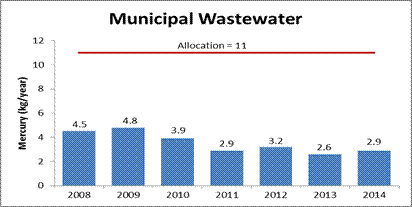
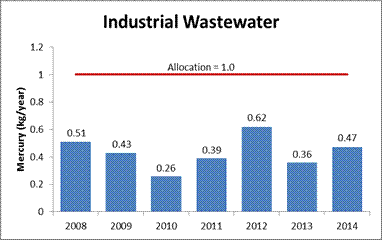
On November 1, 2007, the Water Board adopted a Watershed Mercury Permit covering the industrial wastewater and municipal wastewater discharges of mercury to SF Bay identified in the SF Bay Mercury TMDL implementation plan. The permit has been re-issued every five years since 2007. The Watershed Permit is an NPDES permit that implements the wasteload allocations for these two source categories. It also implements other provisions of the TMDL requiring pollution prevention, special studies, and risk reduction actions to be conducted by the permittees. In 2014, the municipal wastewater load was 2.9 kg mercury/year (allocation is 11 kg/yr). The average municipal wastewater load for the past five years has been about 3.1 kg mercury/year, less than half the final TMDL limit of 11 kg mercury/year, which does not come into force until 2028. This outstanding performance has been achieved through strong pollution prevention efforts, excellent solids removal, and intelligent capital upgrades at some treatment plants to improve performance. Municipal wastewater dischargers continue to improve their efforts at reducing mercury through source control activities. All but the smallest municipal wastewater dischargers have implemented dental amalgam control and public outreach and education programs. Additionally, municipal wastewater dischargers have continued to collect hazardous waste, fluorescent lights, thermometers, and batteries, which reduce mercury in municipal storm water runoff. Mercury loadings from industrial wastewater dischargers are considerably lower than municipal wastewater dischargers. In 2014, the industrial wastewater load to the Bay was 0.47 kg mercury/year, well below the final permitted allocation of 1.0 kg mercury/year. |
|
Reducing Risk for Humans Consuming SF Bay Fish
The NPDES permits for municipal wastewater and stormwater contain requirements to implement a regional program of risk communication activities to raise public awareness of fish contamination issues in San Francisco Bay, to encourage fish-consuming populations to reduce their exposure to pollutants in contaminated fish, and to quantify the risk reduction resulting from these communication activities. The dischargers jointly funded the California Department of Public Health to lead efforts to engage stakeholders, including local agencies, tribes, and community groups, in educating the public on how to reduce their exposure to PCBs and mercury when consuming SF Bay fish. This project funded four community-based organizations (California Indian Environmental Alliance, Asian Perinatal Advocates, Greenaction for Health and Environmental Justice, and Kids for the Bay) to undertake risk communication outreach efforts to specific communities at risk of exposure to chemicals from eating fish caught in the Bay. These outreach efforts reached over 7000 individuals, and these individuals have over 22,000 family members who eat San Francisco Bay fish. Pre- and post-activity surveys indicate positive behavior change ranging from 60 percent to 96 percent.
Municipal Regional Permit
The NPDES Municipal Regional Permit is a permit for all NPDES phase I municipal stormwater programs in the Bay Area. This permit implements all mercury-related control measures and wasteload allocations required by the TMDL for stormwater sources. The Municipal Regional Permit is being was re-issued in 2015 (see Section C.11 for mercury controls) and a strong emphasis will be on implementation of green infrastructure treatment elements. Because mercury (in contrast to PCBs) is distributed relatively widely and somewhat uniformly across the landscape, the widespread implementation of these green infrastructure treatment elements along with ongoing aggressive mercury recycling efforts will both play a critical role in achieving the TMDL load allocation for urban runoff. The SF Bay mercury TMDL report estimated that 160 kg mercury/yr comes from urban runoff. The load allocation for this source category is 80 kg/yr with a mid-point loading milestone of 120 kg/yr. Recent loading estimates suggest that this loading milestone has been reached.
Managing Mercury Exposure and Risk in Wetlands
Water Board staff collaborated with scientists at the San Francisco Estuary Institute to prepare an article for a special issue of the journal Environmental Research synthesizing mercury-related data for SF Bay, focusing on the most promising avenues for reducing methylmercury contamination in the Bay Area's aquatic food webs. The article, "Reducing methylmercury accumulation in the food webs of San Francisco Bay and its local watersheds", identifies exposure and risk in Bay Area aquatic food webs and evaluates possible control actions. The authors concluded that the most promising avenues for reducing methylmercury are associated with the tidal marsh restoration projects and salt ponds that surround the Bay.
As an outgrowth of this synthesis, Water Board staff worked with scientists at the San Francisco Estuary Institute to hold a workshop in December 2013 to review existing information and information needs relating to managing mercury in restored tidal marshes in San Francisco Bay. The workshop addressed the state of knowledge regarding the role that wetland restoration and management play in mercury impairment locally and regionally, and helped inform decision-making about monitoring efforts. Contact the staff person listed at the bottom of this page to obtain a summary or complete notes of the workshop.
Water Quality Monitoring
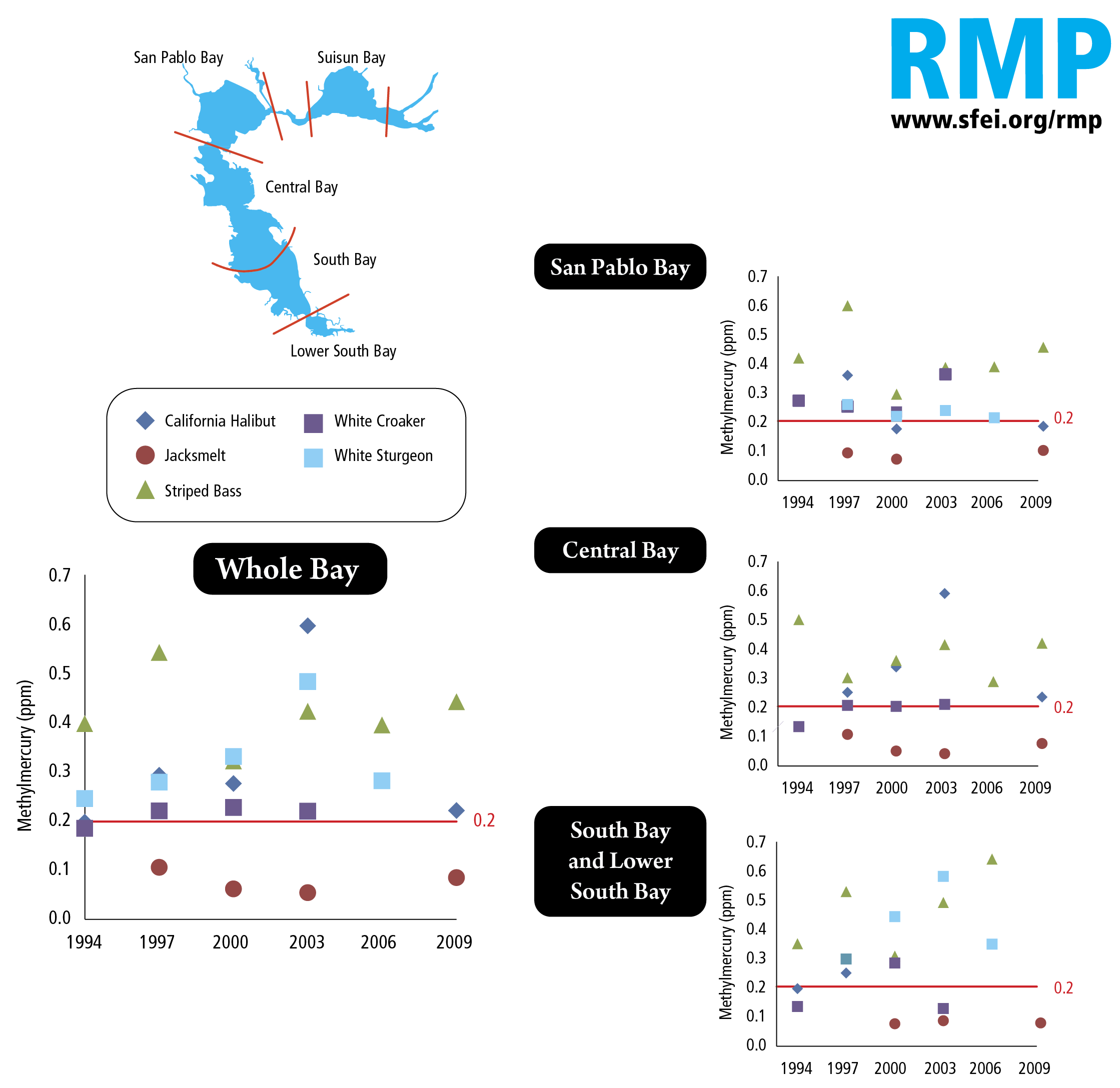
In addition to actions to reduce loads, it is also important to track progress on how the concentrations in the Bay and its biota (e.g. fish and birds) are changing over time. The following are the primary in-situ monitoring efforts for mercury in San Francisco Bay. The Regional Monitoring Program (RMP) measures mercury (and many other contaminants) in water, sediment, and fish tissue collected at several locations around the Bay each year. You can view and download these data for yourself using their versatile data download tool. The RMP has been monitoring contaminants in prey fish (small fish consumed by birds or larger fish) for several years because these small prey fish provide useful information on the spatial and temporal patterns of contamination in the Bay because they tend not to move around as much as large fish. Moreover, these prey fish are consumed by many birds and larger fish so can provide an early warning for contamination higher in the food web (e.g. for larger predators like fish and birds). A summary report on the results of the monitoring program for small fish provides data and interpretation from monitoring efforts. Since 1994, the RMP has also been monitoring the concentrations of mercury and other contaminants in sport fish. A recent report comparing the concentrations of contaminants in sport fish caught in the Bay to those in caught offshore is also available. The figure below shows how mercury concentrations in sport fish change through time in different parts of the Bay and how these concentrations compare to the 0.2 parts per million fish tissue target from the TMDL. |
 |
Piscivorous birds (birds that consume fish) are among the organisms in the Bay that are most sensitive to mercury contamination. Scientists at the United States Geological Survey have been investigating how mercury can affect birds, particularly in the South Bay, and they describe their research and provide results at this website.
Regulating Mercury Mines
The region-wide Mine Cleanup Program was the subject of an update to the Water Board in March 2016 (Contact the staff person listed at the bottom of this page to obtain the report). Water Board staff is currently focusing on two high priority mercury mines, Bella Oaks mine in Napa County and St. John’s mine in Solano County. In 2012, staff inspected Bella Oaks. The landowner is cooperative, as demonstrated by readily providing site access for inspections. The landowner inherited this property, and reportedly has placed a conservation easement on it. There are large piles of eroding calcines (processed mercury ores), but the rate of erosion is relatively low because the portions of the property containing calcines have shallow slopes and some are vegetated. Staff recommends erosion control (grading and vegetation) of the calcine piles. However, the landowner claims to lack financial resources to remediate the mine. For the fiscal year (FY 2013/14), staff identified a regulatory or funding path to accomplish remediation of the Bella Oaks mine. In contrast, St. John’s mine in Solano County has only small piles of mining waste and very steep slopes. For the next fiscal year, staff plans to review the mercury discharge threat posed by St. John’s mining wastes. If staff determines there is a significant remaining threat, we intend to identify a local enforcement agency to address this complicated mine site, which extends over numerous parcels owned by both private parties and public agencies.
Achieving the SF Bay Mercury TMDL also depends on addressing the mining legacy mercury contamination in the Guadalupe River watershed through implementation of the Guadalupe River Mercury TMDL. There are many implementation activities already underway that are yielding tangible load reductions, and the Water Board website describes these in detail.
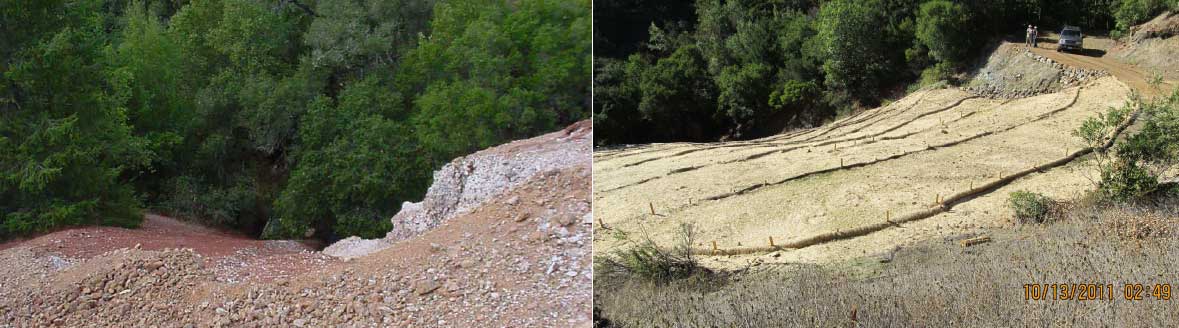
Photos show the La Joya mercury mine tailings pile before (left) and after (right) the construction and remediation project to stabilize the material and prevent erosion and transport.
There are a lot of implementation activities in the Guadalupe River watershed addressing the legacy of mercury mining impacts..
Bay Area Petroleum Refineries - Fate of Crude Oil Mercury
The mercury TMDL implementation plan identified an information gap associated with Bay Area petroleum refineries. The information gap was an apparent mismatch between the potentially large amount of mercury entering the refineries in crude oil and the much smaller quantity of mercury that could be accounted for leaving refineries in various product and waste streams. In 2007, the Executive Officer of the Water Board formally ordered the petroleum refineries to submit technical reports to address this information gap, and the final report for the study was received in June 2009. Contact the staff person listed at the bottom of this page to obtain the order and final report.
The study results suggest that about 220 kg/yr of mercury enters petroleum refineries in crude oil. This amount, based on actual measurements of mercury in crude oil, is much less than the amount estimated by staff using literature values for mercury concentration in crude oil. The mass balance also suggests that the vast majority of this mercury leaves the refineries in solid waste that is transferred to off-site solid waste disposal facilities. Less than 10% of the input mercury is emitted directly to the air from stacks, and roughly 10% of the mercury leaves the petroleum refineries in various products like automobile fuel and fuel oil. Small amounts were also contained in petroleum coke (1%) and wastewater (< 1%).
Other Documents
- How TMDLs Are Adopted: The Basin Planning Process, February 2004 (PDF file)
- Legacy Pollution: What Does it Mean for the Health of the Bay, Fact Sheet, March 2003, (PDF file)
Links
U.S. Environmental Protection AgencyU.S. Geological Survey
For more information contact:
email Richard Looker (Richard.Looker@waterboards.ca.gov)
Water Resource Control Engineer
San Francisco Bay Regional Water Quality Control Board
1515 Clay Street, Suite 1400
Oakland, CA 94612
Phone: 510-622-2451
Fax: 510-622-2460

