

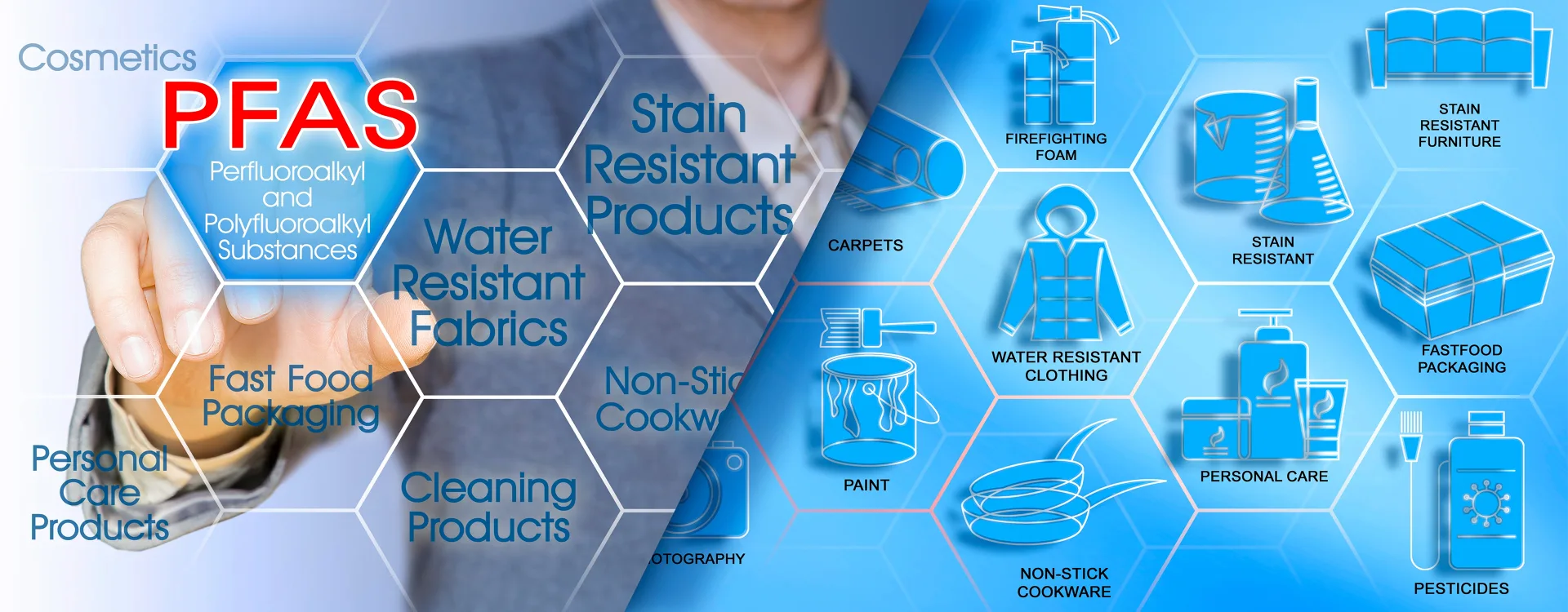
A rain jacket that shed water while remaining surprisingly light and breathable. A restaurant takeout container that kept grease from soaking through. Firefighting foam that could rapidly extinguish dangerous fuel fires.
For decades, innovations like these relied on a family of chemicals known as PFAS.
At the time, PFAS seemed almost magical. The chemicals resisted water, grease and heat with remarkable effectiveness, helping create products that were safer, more durable and more convenient. Manufacturers found uses for them everywhere.
Then scientists discovered the catch.
Studies linked exposure to PFAS to harm to human health, including cancer, developmental effects on fetuses, and adverse impacts on the liver, immune system, thyroid and more.
The same chemical properties that made PFAS so useful also made them extraordinarily persistent. Instead of breaking down, some PFAS compounds could remain in the environment for years — even decades — finding their way into the air, soil, groundwater and drinking water supplies.
History is full of innovations that transformed daily life before their unintended consequences became apparent. PFAS may be the latest example.
What once looked like a technological breakthrough suddenly presented a new challenge for scientists, regulators and water providers alike: How do you address a class of chemicals that may include more than 14,000 compounds, many of which are only beginning to be understood?
For Daniel Newton, a water resource control engineer and an assistant deputy director with the State Water Resources Control Board’s Division of Drinking Water, the scale of the challenge became clear almost immediately.
“There were 14,000 analytes, and we were just touching the tip of the iceberg,” he said.
Starting with more questions than answers
When California began its PFAS investigation several years ago, scientists knew surprisingly little about the extent of contamination across the state.
Researchers understood that PFAS had been used for decades in countless products and industrial applications. What they didn’t know was how widespread the contamination might be, which compounds posed the greatest concern, or whether traditional approaches to regulation would be enough.
That uncertainty drew together scientists and engineers from across the Water Boards.
Among them was Wendy Linck, a senior engineering geologist with the Division of Water Quality. After a long career in consulting, she joined state service expecting fewer surprises.
Instead, she found herself helping lead one of California’s most ambitious environmental investigations.
“I knew zero about PFAS when I started,” Linck said.
What followed was years of monitoring, research and collaboration involving drinking water experts, water systems, environmental justice advocates, local communities and state scientists.
Together, they set out to answer a basic question: What exactly are we dealing with?
Testing showed less well contamination than feared
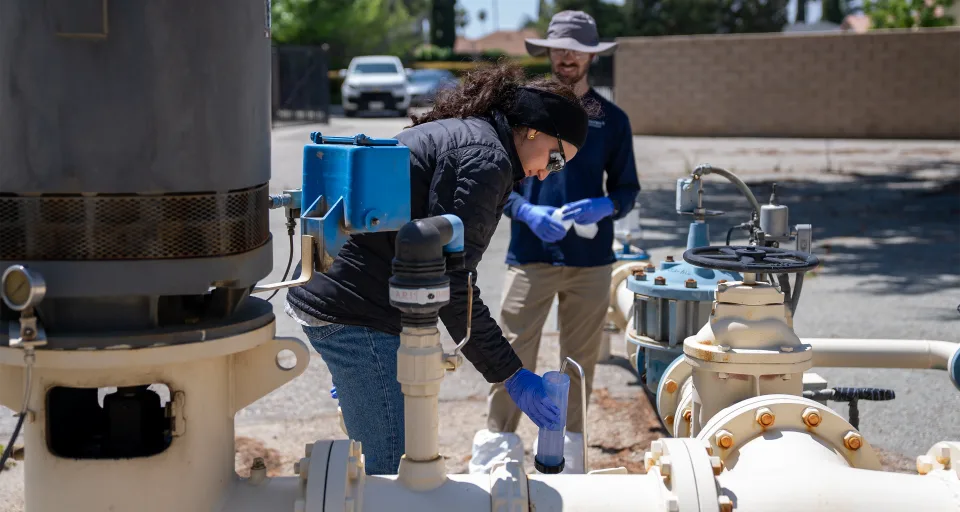
The Water Boards launched extensive monitoring efforts to identify where PFAS was found, and which specific compounds were showing up most often.

“When we started, I thought PFAS was so ubiquitous that we were going to find it in every well.”
— Daniel Newton, Division of Drinking Water Assistant Deputy Director
One of the most significant efforts was a multiyear statewide study of disadvantaged communities that sampled 3,422 wells in 51 of California’s 58 counties.
The results challenged some assumptions.
“When we started, I thought PFAS was so ubiquitous that we were going to find it in every well,” Newton said.
Instead, the data revealed a more nuanced picture. Among the PFAS compounds currently monitored through targeted testing methods, only about 17% of wells sampled contained either PFOA or PFOS — the two compounds most commonly detected in California drinking water sources. The compounds were frequently found together.
That finding didn’t eliminate concern, but it provided something equally important: a clearer path forward.
Certain compounds appeared repeatedly. Certain regions shared similar characteristics. Scientists began searching for PFAS “signatures” that could help explain where contamination originated and how best to address it.
The information gathered through the study is helping California develop a treatment-based approach that looks beyond individual compounds and toward managing PFAS as a broader class of chemicals.
For the first time, the fog was beginning to lift.
Looking beyond the chemicals we know
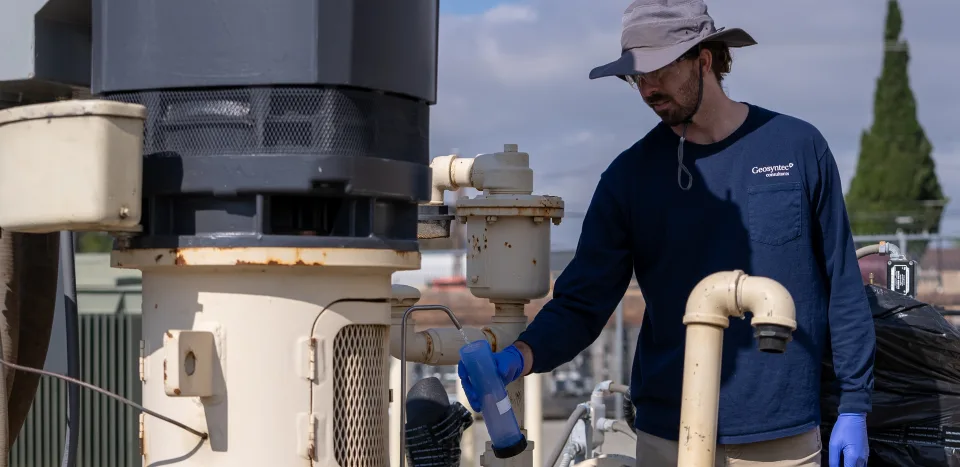
Most PFAS investigations focus on a relatively small number of compounds that can be measured using established laboratory methods.
California wanted to look further.
Using advanced analytical techniques known as non-targeted analysis, and total organic fluorine methods, scientists began searching for PFAS compounds and the total amount of PFAS mass.
The effort reflects a broader shift in how the state is approaching the challenge.
Historically, contaminants have often been studied and regulated one chemical at a time.
PFAS may require a different strategy.
Rather than chasing thousands of compounds individually, scientists are exploring ways to understand PFAS as a class and identify “sentinel PFAS” that could serve as indicators for larger groups of related chemicals.
“This is where California is really going way ahead,” Newton said.
The goal is not simply to understand today’s PFAS compounds, but to build a framework that can help address future ones as well.
A changing federal regulatory landscape
As California’s PFAS investigation has evolved, so has the federal government’s approach.
In 2024, the U.S. Environmental Protection Agency adopted the nation’s first enforceable drinking water standards for six PFAS compounds, marking a major milestone in the effort to address “forever chemicals.”
More recently, EPA announced plans to retain drinking water standards for PFOA and PFOS while reconsidering standards for four other analytes (PFHxS, PFNA, PFBS and HFPO-DA), as well as the agency’s Hazard Index approach for certain PFAS mixtures.
While these changes have generated national attention, they should not impact California. State Water Board scientists estimate that approximately 98% of PFAS contamination identified in the state’s drinking water sources contains PFOA and/or PFOS—the analytes for which EPA is keeping the 2024 standards in place.
Additionally, treatment systems designed to remove these compounds are expected to eliminate the other four analytes as well.
From uncertainty to understanding

“What is emerging is a much clearer picture of which PFAS compounds matter most. It’s not as scary as it was.”
— Wendy Linck, Senior Engineering Geologist
The Water Boards’ monitoring efforts, research initiatives and advanced analytical work are helping answer questions that go beyond any single drinking water standard: Which PFAS compounds are present in California? How are they moving through the environment? Which compounds matter most? And can PFAS ultimately be understood and addressed as a class rather than one chemical at a time?
Linck often describes the journey to understanding PFAS using a simple image.
Imagine a funnel.
At the top are more than 14,000 PFAS compounds swirling together in a confusing mix of possibilities and unanswered questions.
Several years ago, that was where California stood.
Monitoring programs, targeted testing and cutting-edge analytical methods have dramatically narrowed the field.
“We’re getting an idea of what’s really going to come out of the bottom of that funnel,” Linck said. “What is emerging is a much clearer picture of which PFAS compounds matter most.”
While scientists began with a universe of more than 14,000 chemicals, monitoring data increasingly point to a much smaller group of compounds that account for most detections in California drinking water sources, particularly PFOA and PFOS.
As a result, the challenge feels less overwhelming than it once did.
“It’s not as scary as it was,” Linck said.
Not because PFAS has disappeared, but because California now has better tools, better data and a much clearer understanding of where to focus its efforts.