Agricultural Lands Discharge Program
Note: Please sign up for the email list here to stay informed on the latest program developments and stakeholder outreach efforts.
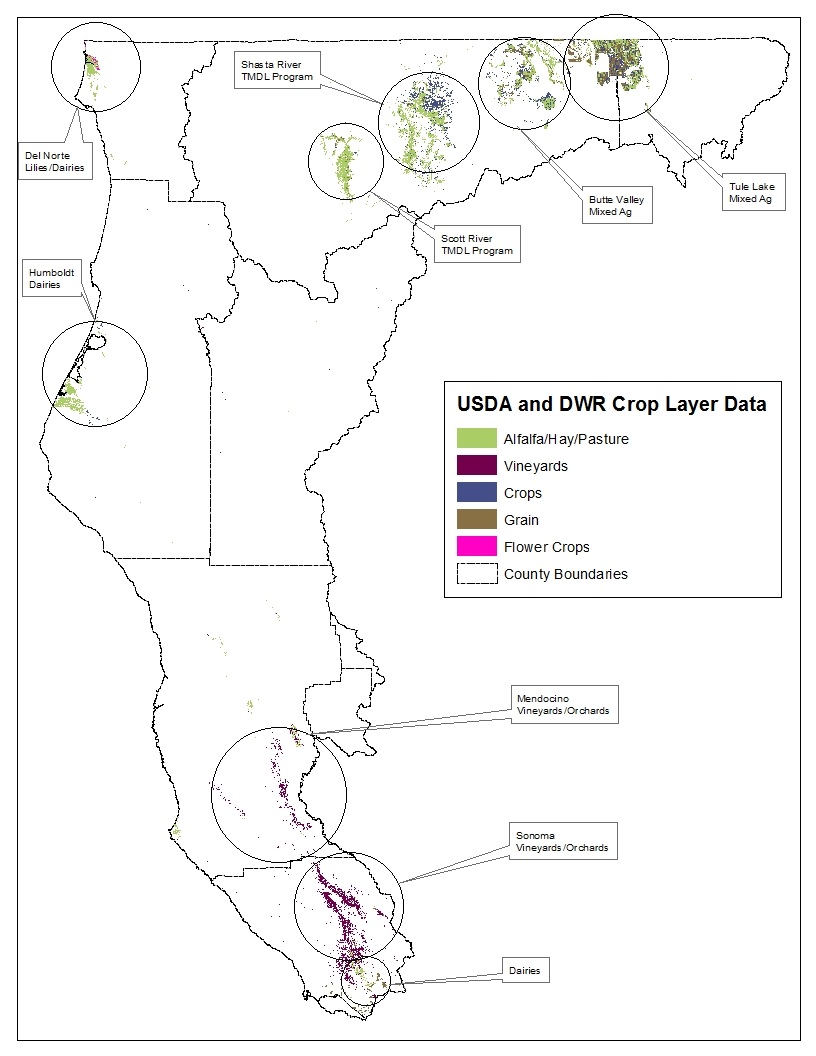
The Agricultural Lands Discharge Program (Program) addresses water quality impacts associated with activities on agricultural lands in the North Coast Region (Region). There are approximately 350,000 acres of agricultural lands in the Region, which are primarily used for vineyards, orchards, row crops, grain, alfalfa, hay pasture, and dairies. Agricultural discharges can contain pollutants such as pesticides, nutrients, organic matter, salts, pathogens, and sediment. These pollutants can harm aquatic life or make surface or groundwater unusable for drinking water or agricultural uses. Activities on agricultural lands can also result in the removal or suppression of riparian vegetation, which provide shade and other ecological functions to waterbodies. The Program is designed to meet the requirements of the California Water Code, the State Nonpoint Source Policy, and the Total Maximum Daily Loads (TMDLs) developed for certain watersheds in the Region.
The Program as a whole encompasses several separate Regional Water Board permits that address discharges of waste associated with agricultural lands. The scope of the program is defined by either the crop type or geographic location. Links to the web pages for the existing permits and the permits currently under development are provided below.
Cannabis Cultivation Discharges
Dairies
National Forest Cattle Grazing and Other Nonpoint Sources
Scott River Agricultural Operations
Shasta River Agricultural Operations
Separate permits and programs are being developed to address discharges associated with agricultural activities in the following geographic areas or for the following crop types.
Vineyards and Orchards
Lily Bulb Production
Tule Lake Basin
Stakeholder Involvement
In 2011, Regional Water Board staff formed a Stakeholder Advisory Group made up of representatives of stakeholder interests to provide input to Regional Water Board staff on the development of a regionwide permitting program for agricultural lands. At the September 2013 Regional Water Board meeting, the Board directed staff to develop separate permits on a commodity and geographic basis as opposed to an all-encompassing regionwide program.
To adapt the Stakeholder Advisory Group process to the new approach, the group was divided into three smaller sub-groups focused on developing the permit pertaining to their geographic area or commodity. While meetings of the Stakeholder Advisory Groups are open to the public, general public participation is limited to allow for more extensive dialogue among Advisory Group members. Advisory Group members are expected to represent the interests of their organizations/constituency at meetings. Current Stakeholder Advisory Group membership lists are provided on the specific program pages.
Various materials related to the Stakeholder Advisory Group process through September 2013 are available through this link:
Working Documents
The following documents are products of the Stakeholder Advisory Group developed prior to September 2013 as part of the development of a regionwide permit. Much of the content can be applied to the development of the separate commodity/area-specific permits and will be used as those permits continue to be developed.
- Draft Agricultural Lands Discharge Program Scope and Framework - September 5, 2012
- Draft Ag Lands Conditional Waiver Overview and Portions of Draft Conditional Waiver Language - September 28, 2012
- Draft Water Quality Management Plans - September 28, 2012
- Frequently Asked Legal/Policy Questions
- Frequently Asked Program Development Questions
Staff Presentations to the Regional Water Board and Reports
March 8, 2017 Regional Water Board Meeting, Fortuna
- Executive Officer’s Summary Report - March 2017
- Powerpoint Presentation - March 2017
- Audio - March 2017
January 29, 2015 Regional Water Board Meeting, Santa Rosa
- Executive Officer's Summary Report - Jan. 2015
- Powerpoint Presentation - Jan. 2015
- Audio - Jan. 2015
September 26, 2013 Regional Water Board Meeting, Fortuna
- Executive Officer's Summary Report - Sept. 2013
- Powerpoint Presentation - Sept. 2013
- North Coast Region Agriculture Map - Sept. 2013
- North Coast Region Timberland Map - Sept. 2013
- Audio - Sept. 2013
May 2, 2013 Regional Water Board Meeting, Eureka
October 4, 2012 Regional Water Board Meeting, Yreka
- Executive Officer's Summary Report - Oct. 2012
- Powerpoint Presentation - Oct. 2012
- Audio - Oct. 2012
January 19, 2012 Regional Water Board Meeting, Santa Rosa
May 5, 2011 Regional Water Board Meeting, Eureka
March 24, 2011 Regional Water Board Meeting, Weaverville
January 27, 2011 Regional Water Board Meeting, Santa Rosa
June 10, 2010 Regional Water Board Meeting, Santa Rosa
- Executive Officer's Summary Report - June 2010
- Powerpoint Presentation - June 2010
- Audio - June 2010
References
Mailing List
Interested parties are encouraged to sign up on the email list below to receive information about stakeholder involvement opportunities and updates on progress to develop the various programs and permits:
Email List: Agricultural Lands Discharge Program Email List Subscription Page
(Page last updated 4/10/24)
Water is a precious resource in California, and maintaining its quality is of utmost importance to safeguard the health of the public and the environment.
Statewide Campaigns
EPA Water Sense
File an Environmental Complaint
Save Our Water
Flex Alert
Register to Vote