


Statewide Mercury Provisions
Addressing Mercury in California's Waters
Mercury is negatively impacting the beneficial uses of many waters of the state by making fish unsafe for human and wildlife consumption. Although mercury occurs naturally in the environment, concentrations of mercury exceed background levels because of human activities. Gold and mercury mines and atmospheric deposition are the predominant sources of mercury, with minor contributions from industrial and municipal wastewater discharges and urban run-off.
On May 2, 2017, the State Water Resources Control Board adopted Resolution 2017-0027, which approved "Part 2 of the Water Quality Control Plan for Inland Surface Waters, Enclosed Bays, and Estuaries of California—Tribal and Subsistence Fishing Beneficial Uses and Mercury Provisions." Resolution 2017-0027 provides a consistent regulatory approach throughout the state by setting mercury limits to protect the beneficial uses associated with the consumption of fish by both people and wildlife. Additionally, the State Water Board established three new beneficial use definitions for use the State and Regional Water Boards in designating Tribal Traditional Culture (CUL), Tribal Subsistence Fishing (T-SUB), and Subsistence Fishing (SUB) beneficial uses to inland surface waters, enclosed bays, or estuaries in the state. The State Water Board approved one new narrative and four new numeric mercury objectives to apply to those inland surface waters, enclosed bays, and estuaries of the state that have any of the following beneficial use definitions: COMM, CUL, T-SUB, WILD, MAR, RARE, WARM, COLD, EST, or SAL, with the exception of waterbodies or waterbody segments with site-specific mercury objectives. These provisions will be implemented through National Pollution Discharge Elimination System permits, water quality certifications, waste discharge requirements (WDRs) and waivers of WDRs.
Announcements
- NEW! Final Provisions are available.
Final Part 2 of the Water Quality Control Plan for Inland Surface Waters, Enclosed Bays, and Estuaries of California - Tribal and Subsistence Fishing Beneficial Uses and Mercury Provisions
PREVIOUS ANNOUNCEMENTS
- U.S. ENVIRONMENTAL PROTECTION AGENCY APPROVAL
The U.S. Environmental Protection Agency has approved State Water Resources Control Board Resolution no. 2017-027 pursuant to section 303(c) of the Clean Water Act and 40 Code of Federal Regulations Part 131.
- OFFICE OF ADMINISTRATIVE LAW APPROVAL
The Office of Administrative Law has approved State Water Resources Control Board Resolution No. 2017-0027 pursuant to section 11353 of the Government Code.
- FINAL DOCUMENTS AVAILABLE
On May 2, 2017, the State Water Resources Control Board adopted Resolution No. 2017-0027, Part 2 of the Water Quality Control Plan for Inland Surface Waters, Enclosed Bays, and Estuaries of California—Tribal and Subsistence Fishing Beneficial Uses and Mercury Provisions.
The State Water Board has also released the Final Regulatory Language (Appendix A of the Final Staff Report). The Final Regulatory Language and the Final Staff Report, available as separate PDFs at these links:
- Final Regulatory Language (Appendix A)
- Final Staff Report (excluding Appendix A)
Changes made to the Draft Resolution and the Revised Draft Final Part 2 of the Water Quality Control Plan for Inland Surface Waters, Enclosed Bays, and Estuaries of California-Tribal and Subsistence Fishing Beneficial Uses and Mercury Provisions are available in Change Sheet #1 (Circulated May 1, 2017)
- May 2, 2017 MEETING DOCUMENTS AVAILABLE
The Clerk to the Board has posted the Agenda for the May 2, 2017 Board Meeting. The Board will consider a proposed Resolution adopting the Proposed Part 2 of the Water Quality Control Plan for Inland Surface Waters, Enclosed Bays, and Estuaries of California-Tribal and Subsistence Fishing Beneficial Uses and Mercury Provisions (Item 6).
Draft Resolution and the description of the Agenda Item (number 6).
The Summary of the Revisions to the Proposed Final Staff Report and Proposed Final Amendments.
- Link to Public Comments
Public Comments regarding Beneficial Uses and Mercury Objectives - Link to Peer Review Documents
Water Boards Peer Review documents - NOTICE OF PUBLIC MEETING AND CONSIDERATION OF ADOPTION
The State Water Board will hold a public meeting on May 2, 2017 to consider (1) adoption of the proposed Part 2 of the Water Quality Control Plan for Inland Surface Waters, Enclosed Bays, and Estuaries of California - Tribal and Subsistence Fishing Beneficial Uses and Mercury Provisions (referred to as the proposed Final Provisions) and (2) approval of the Final Staff Report, including the Substitute Environmental Documentation (SED). The proposed Final Provisions and Final Staff Report will be released to the public no later than April 22, 2017. The State Water Board will not provide a written comment period for the revisions made to the January 2017 Draft Provisions and Draft Staff Report that will be reflected in the proposed Final Provisions and Final Staff Report; therefore written comments will not be considered. Interested persons may provide oral comments at the public meeting.
The complete Notice, including time and location of the meeting.
-
The State Water Board held a public hearing on February 7, 2017 to receive public input and comments on the Provisions and the Draft Staff Report, including the Draft SED. A quorum of the State Water Board was not present; and no Board action was taken.
The Notice of Opportunity for Public Comment, Staff Workshop, Public Hearing, and Notice of Filing. Instructions for submitting comments are included in the notice. The commenting period closed on February 17, 2017 at 12:00 noon. Information on documents for public comment is available on the State Water Board’s Documents for Public Comment page.
For more information about the fish tissue methylmercury objectives, contact dwq-ipsi@waterboards.ca.gov or MercuryProvisions@waterboards.ca.gov
- NOTICE OF CONTINUATION OF STAFF WORKSHOP
State Water Board staff held a workshop on January 9, 2017 to explain the draft regulatory language and facilitate public comments. Staff is continuing that workshop to discuss potential instream flow or water supply implications that could be associated with the designation of the proposed beneficial uses, including the Tribal Tradition and Culture, Tribal Subsistence Fishing, and Subsistence Fishing beneficial uses. At the staff workshop, staff will present information focusing on the interplay between the proposed beneficial uses and potential instream flow requirements, and the process by which protection of such uses would occur.
The new workshop will take place on February 1, 2017, from 10:00 a.m. to 12:30 p.m., at the CalEPA Headquarters Building at 1001 I Street, Sacramento, CA in the Sierra Hearing Room. Workshop Notice
Note that this workshop will be conducted by staff, but less than a quorum of board members may be present. No board action will be taken at the conclusion of the workshop.
- OPPORTUNITY FOR PUBLIC COMMENT & DOCUMENT AVAILABLE
The Draft Staff Report, including the Draft Substitute Environmental Documentation (Draft SED), for the proposed Part 2 of the Water Quality Control Plan for Inland Surface Waters, Enclosed Bays, and Estuaries of California - Tribal and Subsistence Fishing Beneficial Uses and Mercury Provisions (the Provisions) is available as of January 3, 2017. The Provisions include proposed statewide mercury water quality objectives. The revised Notice of Opportunity for Public Comment, Staff Workshop, Public Hearing and Notice of Filing.
-
The proposed Provisions and Draft Staff Report and SED is a very large document. Staff have broken up the documents into sections that will allow more user-friendly navigation, and are downloadable as individual PDF files. In the table below, click on the link in the Document Section column to download a PDF of the sections described. The new uploaded Document Sections contain changes to the page numbers of the staff report, and formatting corrections to Appendix A's headings.
Document Section Description Staff Report The Executive Summary and Chapters 1 - 10 of the Staff Report and SED Appendix A Proposed Provisions for Draft Part 2 of the Water Quality Control Plan for Inland Surface Waters, Enclosed Bays, and Estuaries of California-Tribal and Subsistence Fishing Beneficial Uses (proposed Regulatory Language) Appendix B Abbreviations and Definitions Appendix C List of Waters Impaired By Mercury Appendix D Description of the Nine Water Board Regions Appendix E Related Government Mercury Programs Appendix F Abandoned Mines and Suction Dredge Mining Appendix G Fish Consumption Studies Appendix H Calculation of the Human Health Objectives Appendix I Calculation of the Water Column Targets Appendix J Review of Effects on Wildlife Appendix K Wildlife Targets Appendix L Derivation of Trophic Level Ratios Appendix M Summary of Mercury TMDLs Appendix N Wastewater and Industrial Discharges Appendix O Methods to Measure Mercury Appendix P Storm Water Permits Appendix Q Wetland Studies Appendix R Economic Analysis Appendix S Responses to the External Peer Review Appendix T Development of Beneficial Uses Appendix U Overriding Considerations -
The State Water Board will receive public comments on the proposed Provisions starting on January 3, 2017.
State Water Board staff held a staff workshop on January 9, 2017 to provide the public an opportunity to discuss the Provisions. No Board action was taken. Staff gave two presentations. The first presentation was on the proposed Mercury Water Quality Objectives and the proposed program of implementation. The second presentation was on the proposed beneficial uses. Links to the presentation documents in PDF form are below:
- Introduction and Proposed Mercury Water Quality Objectives Presentation
- Proposed Beneficial Uses Presentation
A video recording of the staff workshop is available on the State Water Board's YouTube channel.
Beneficial Uses: Tribal Traditional Cultural, Tribal Subsistence Fishing, and Subsistence Fishing
The State Water Board is developing beneficial categories pertaining to tribal traditional and cultural practices, tribal subsistence fishing, and subsistence fishing by other cultures or individuals. For more information, see:
The beneficial uses will be released for public comment and considered for adoption by the State Water Board as part of the Mercury Water Quality Objectives project. These beneficial uses will be included in the Mercury Water Quality Objectives project since these beneficial uses include fish consumption and the Mercury Water Quality Objectives will protect fish consumption.
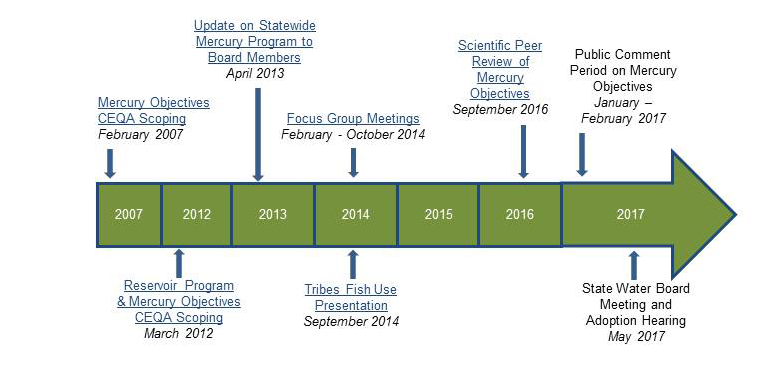
Timeline
This timeline shows the development of the Statewide Mercury Program. The presentation materials from the listed events, including the CEQA scoping documents and comment letters, are available for your review.
Subscribe to receive information by email about the Statewide Fish Tissue Objectives Project and/or the Statewide Mercury Control Program for Reservoirs. After subscribing, you will need to check your email host for a confirmation email to complete the subscription.
Subscribe to our other email lists. See the "Water Quality" section.

