



Ocean Plan Requirements for Seawater Desalination Facilities
Seawater Desalination Overview
Desalination facilities produce freshwater by removing salts from brackish or saltwater for municipal, industrial, or other uses. Seawater desalination draws water from the ocean and passes the water through a membrane, resulting in an amount of fresh water and an amount of high-salinity waste brine. The Ocean Plan includes requirements to ensure the construction and operation of seawater desalination facilities minimize intake and mortality of all forms of marine life. Mitigation measures are required to address harmful impacts to marine life that occur even when a desalination facility uses the best available site, design, and technology feasible. State Water Board Resources Control Board Resolution 2015-0033 describes the responsibility regarding the siting, planning, construction, and operation of desalination plants in the state of California.
Stay Informed
Email Subscriptions
Subscribe to the California Ocean Plan (COP) email topic to receive notifications and the latest updates.
Ocean Plan Chapter III.M
Click on the image to access the California Ocean Plan
Click on the image to access the Final Staff Report
On May 6, 2015, the State Water Board adopted an amendment to the Water Quality Control Plan for Ocean Waters of California (Ocean Plan) to address effects associated with the construction and operation of seawater desalination facilities (Desalination Regulations). The Desalination Regulations support the use of ocean water as a reliable supplement to traditional water supplies while protecting marine life and water quality. The Desalination Regulations, found in Chapter III.M of the Ocean Plan, provide a uniform, consistent process for permitting seawater desalination facilities statewide. In doing so, it provides direction for regional water boards when permitting new or expanded facilities and outlines specific implementation and monitoring and reporting requirements. The Office of Administrative Law approved the Desalination Regulations on January 28, 2016. The United States Environmental Protection Agency approved the portions of the Desalination Regulations that implement the federal Clean Water Act on April 7, 2016. Therefore, the Desalination Regulations are fully in effect.
The Desalination Regulations require new or expanded seawater desalination plants to use the best available, site, design, technology, and mitigation measures feasible to minimize intake and mortality of all forms of marine life. Based on the best available science, the Desalination Regulations identify preferred technologies; however, alternative intake and disposal methods can be used if demonstrated to be as protective of marine life as the preferred technologies. Additionally, the Desalination Regulations require mitigation measures to address harmful impacts on marine life that occur after a desalination facility uses the best available site, design, and technology feasible. Feasibility considerations regarding site, design, technology, and mitigation measures take into account economic, environmental, social, and technological factors and whether something is capable of being accomplished in a successful manner within a reasonable period of time.
Seawater Desalination Facilities
Resources
- Desalination Plant Entrainment Impacts and Mitigation, October 9, 2013
- Hyper-Salinity Toxicity Thresholds for Nine California Ocean Plan Toxicity Test Protocols, July 2012
- Mitigation and Fees for the Intake of Seawater by Desalination and Power Plants, March 14, 2012
- Management of Brine Discharges to Coastal Waters - Recommendations of a Science Advisory Panel, March 2012
The Seawater Desalination MOA memorializes the relationship between agencies to coordinate timely and effective review of environmental documents and permits or lease applications for proposed seawater desalination facilities, and demonstrates the Water Boards’ ongoing commitment to interagency coordination. The included agencies and their websites can be found below:
Monterey Bay National Marine Sanctuary
California Coastal Commission
National Marine Fisheries Service's West Coast Region
The State Water Board released the Seawater Desalination Interagency Group's Final Seawater Desalination Siting and Streamlining Report to Expedite Permitting to fulfill directives set by California's Water Supply Strategy: Adapting to a Hotter Drier Future. The Draft Report has no regulatory force or effect but includes interagency recommendations to clarify the most efficient permitting process while ensuring appropriate review of projects.
In January 2023, State Water Board staff convened a Seawater Desalination Interagency Group, comprising state and federal agencies to establish criteria agreed upon by multiple state permitting entities for the efficient and timely approval of coastal desalination projects to help address increasing threats to California's water supply while protecting coastal marine environments. The Report has no regulatory force or effect but includes interagency recommendations.
The Draft Report was released for public comment in July and on July 21, 2023, staff held an informational Webinar to share the impetus and approach for developing the Draft Report and provide an overview of its recommendations, including brief presentations from some of the interagency partners involved in this collaborative effort. State agencies incorporated this feedback in the final Report released in December 2023 and are committed to continue to improve permitting efficiency for desalination projects following the governor's acceptance of their recommendations in the Report.
Region 1 – North Coast
Charles Reed
Charles.Reed@waterboards.ca.gov
707 576-2752
Region 2 – San Francisco Bay
Xavier Fernandez
Xavier.Fernandez@waterboards.ca.gov
510 622-5685
Region 3 – Central Coast
Arwen Wyatt-Mair
Arwen.WyattMair@waterboards.ca.gov
805 542-4695
Region 4 – Los Angeles
Jeong-Hee Lim
Jeong-Hee.Lim@waterboards.ca.gov
951 576-6616
Region 8 – Santa Ana
Julio Lara
Julio.Lara@waterboards.ca.gov
951 782-4995
Region 9 – San Diego
Brandi Outwin-Beals
Brandi.Outwin-Beals@waterboards.ca.gov
619 521-5896
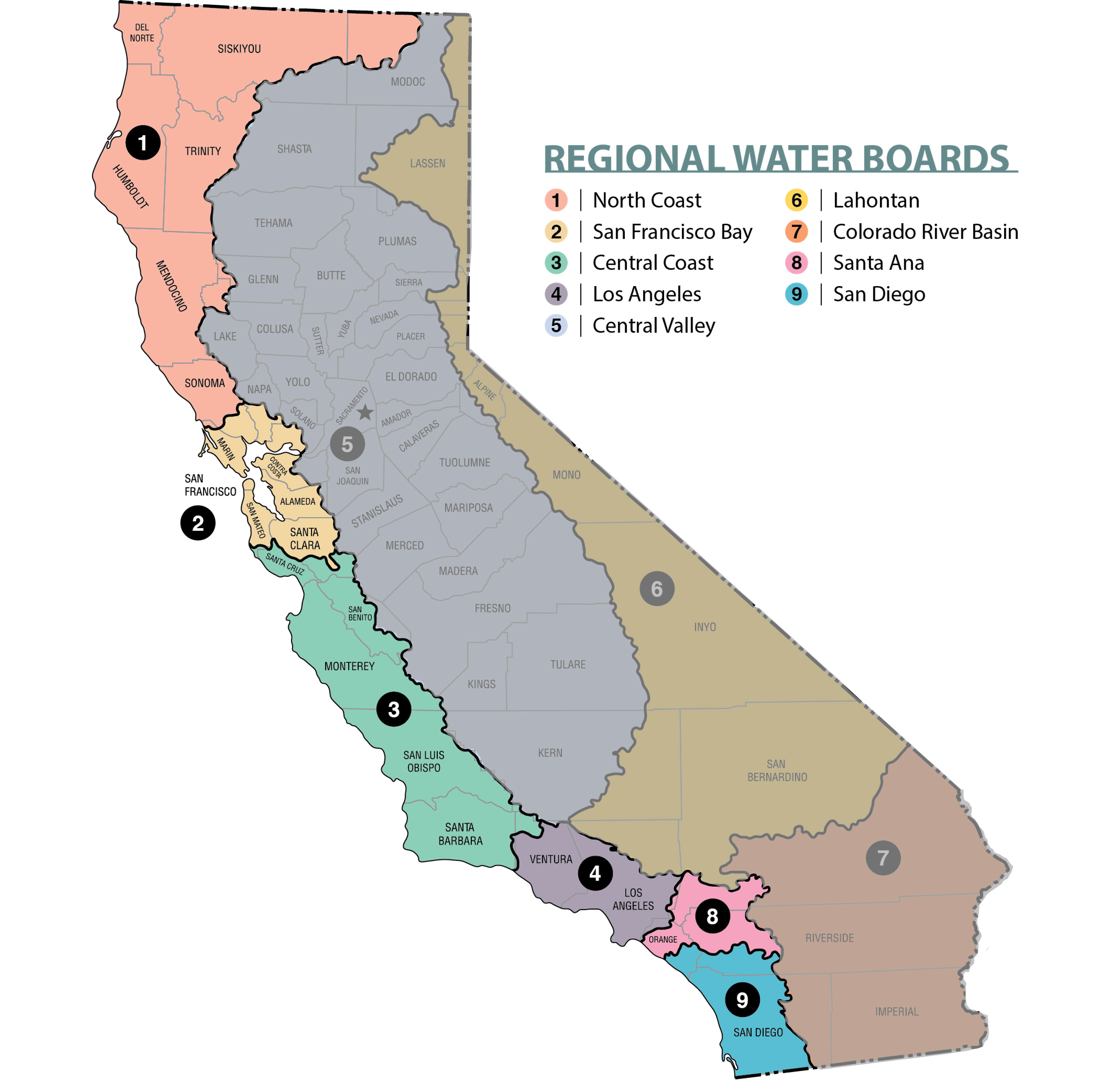
Contact the State Water Board
Jeanie Mascia, Supervisor
Ocean Desalination Unit
Jeanie.Mascia@waterboards.ca.gov
916 323-2871
Gintare Huckeba, Environmental Scientist
Ocean Desalination Unit
Gintare.Huckeba@waterboards.ca.gov
916 323-0684
Christine Manhart, Engineering Geologist
Ocean Desalination Unit
Christine.Manhart@waterboards.ca.gov
916 341-5746

