


Styrene MCL
Rulemaking Status
This rulemaking is in development and has not yet begun.
Inquiries regarding the contents of this regulation may be directed to Melissa.Hall@waterboards.ca.gov.
Background Information
Styrene is a colorless, flammable, highly volatile liquid with a sweet odor (ASTDR 2012). It is widely used in the manufacture of plastics and rubber found in products such as insulation, pipes, automobile components, printer cartridges, food containers, and carpet backing (NIH, 2026). The primary pathway of exposure for the general public is through the inhalation of indoor air contaminated by building materials, consumer products, tobacco smoke, or automobile exhaust (NIH, 2026). Low-level ingestion can also occur via contaminated drinking water. The primary pathway of this is via discharge from rubber and plastic factories and leaching from landfills. Low-level ingestion could occur from migration from polystyrene food containers. Styrene can impact the central nervous system, skin, eyes, and respiratory tract.
In 2011, the National Toxicology Program listed styrene as “reasonably anticipated to be a human carcinogen” in its 12th Report on Carcinogens. Following this classification, the Office of Environmental Health Hazard Assessment (OEHHA) officially added styrene to California’s Proposition 65 list of chemicals known to cause cancer in 2016 (OEHHA, 2016). OEHHA did so pursuant to California's Safe Drinking Water and Toxic Enforcement Act of 1986 (OEHHA, 2016; NIH, 2026). As part of its toxicological evaluation, OEHHA developed health-protective concentrations of 0.5 and 4 µg/L for cancer and noncancer health risks, respectively (OEHHA, 2010). OEHHA also established 0.5 µg/L as the public health goal (PHG) in 2010 (OEHHA, 2010).
The maximum contaminant level (MCL) for styrene in California is 0.1 mg/L (100 µg/L). The rest of this page will use μg/L. This MCL has been in effect since September 1994 (SWRCB, 2026). Under California Health & Safety Code § 116365(a), the State Water Board is required to set MCLs “as close as feasible to the corresponding public health goal [PHG], placing primary emphasis on the protection of public health,” to the extent that it is technologically and economically feasible. The State Water Board maintains a corresponding detection limit for purposes of reporting (DLR) of 0.5 μg/L.
Readers interested in levels of styrene in their drinking water may refer to the water systems' annual Consumer Confidence Reports (CCRs). Many CCRs are available from DDW's Drinking Water Watch website, which also includes other information about drinking water quality.
Occurrence
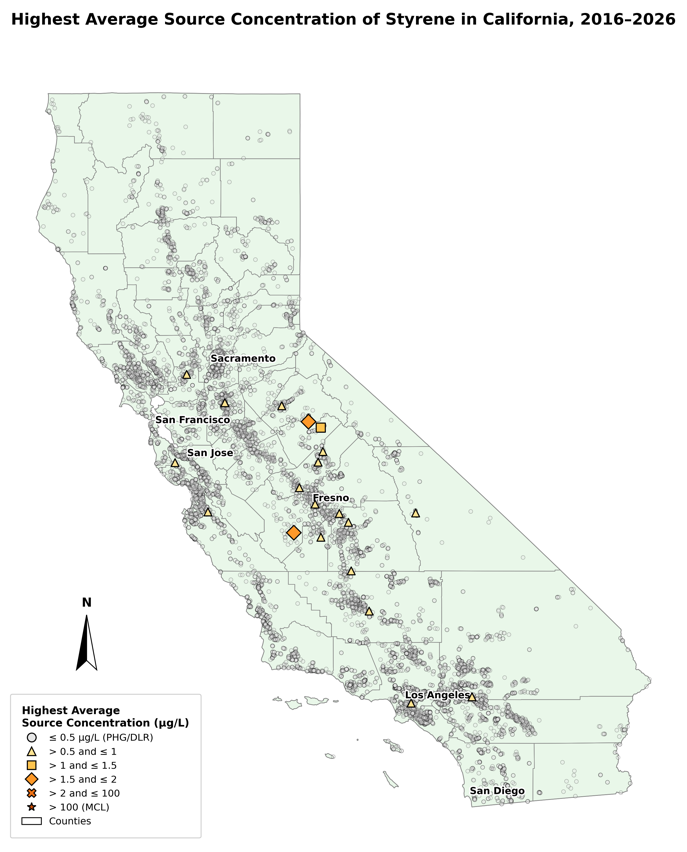
The tables below summarize the Division of Drinking Water's water quality database's reported findings of styrene from January 1, 2016 to April 1, 2026 for community water systems (CWS), non-community non-transient water systems (NTNCWS), and transient non-community water systems (TNCWS). Results reflect the highest running annual average reported for each source. In this case, sources are active wells, springs, infiltration galleries, common headers, and other intakes reporting monitoring results for styrene. Data includes both raw and treated sources.
| Highest Running Annual Average Source Concentration (µg/L) | Community Water Systems | Non-Community Non-Transient Water Systems | Transient Non-Community Water Systems | |||
|---|---|---|---|---|---|---|
| No. of Sources | No. of Systems | No. of Sources | No. of Systems | No. of Sources | No. of Systems | |
| ≤ 0.5 (DLR/PHG) | 8,866 | 2,490 | 1,968 | 1,381 | 180 | 148 |
| > 0.5 and ≤ 1 | 12 | 11 | 4 | 4 | 1 | 1 |
| > 1 and ≤ 1.5 | - | - | 1 | 1 | - | - |
| > 1.5 and ≤ 2 | 2 | 2 | - | - | 1 | 1 |
| > 2 and ≤ 100 | - | - | - | - | - | - |
| > 100 (MCL) | - | - | - | - | - | - |
| Total Tested | 8,880 | 2,503 | 1,973 | 1,386 | 182 | 150 |
| Statewide Total | 9,578 | 2,596 | 2,061 | 1,412 | 3,567 | 2,968 |
| Percent Tested | 92.7% | 96.4% | 95.7% | 98.2% | 5.1% | 5.1% |
The values above should not be considered to reflect styrene in drinking water served to customers, since water from these sources may be blended, treated, or otherwise not used to provide drinking water.
For more information about the quality of specific drinking water supplies, see public water systems' annual Consumer Confidence Reports.
The sampling results in the table above were obtained from laboratories using one of the following ELAP accredited methods:
- EPA Method 502.2: Volatile Organic Compounds in Water by Purge and Trap Capillary Column Gas Chromatography with Photoionization and Electrolytic Conductivity Detectors in Series (1989)
- EPA Method 524.2: Measurement of Purgeable Organic Compounds in Water by Capillary Column Gas Chromatography/Mass Spectrometry (1995)
- EPA Method 524.3: Measurement of Purgeable Organic Compounds in Water by Capillary Column Gas Chromatography/Mass Spectrometry (2009)
- EPA Method 524.4: Measurement of Purgeable Organic Compounds in Water by Gas Chromatography/Mass Spectrometry Using Nitrogen Purge Gas (2013)
Styrene Average Source Concentrations in 2026
Rulemaking Proceedings
- Notice of Proposed Rulemaking Published: TBD
- Close of the 45-Day Public Comment Period: TBD
- Date of Scheduled Public Hearings: TBD
- Date filed with Office of Administrative Law: TBD
- Approved by Office of Administrative Law: TBD
- Filed with the Secretary of State: TBD
- Effective Date: TBD
Sections Affected
- California Code of Regulations, Title 22, sections TBD
Rulemaking File
- TBD
Stay informed
Join the Mailing List
Subscribe to the Drinking Water Program Announcements email topic to receive notifications and the latest updates.
Contact Us
State Water Resources Control Board
Division of Drinking Water
Regulatory Development Unit
Mailing Address:
P.O. Box 100
Sacramento, CA 95812-0100
Street Address:
1001 I Street
Sacramento, CA 95814
E-mail us at DDWRegUnit@waterboards.ca.gov.

